



Key Takeaways
- Goldman Sachs reaffirms its year-end 2026 price target of $5,400 per troy ounce for gold
- March 2026 saw gold decline approximately 13–15%, marking its largest monthly percentage loss in nearly two decades
- Middle East hostilities and inflation concerns have led markets to discount Federal Reserve easing
- Renewed central bank accumulation is anticipated to provide price support
- A bear case scenario projects potential downside to $3,800 under deteriorating conditions
Goldman Sachs continues to project gold will climb to $5,400 per troy ounce by December 2026. The investment bank published this outlook in research dated Monday, March 31, 2026.
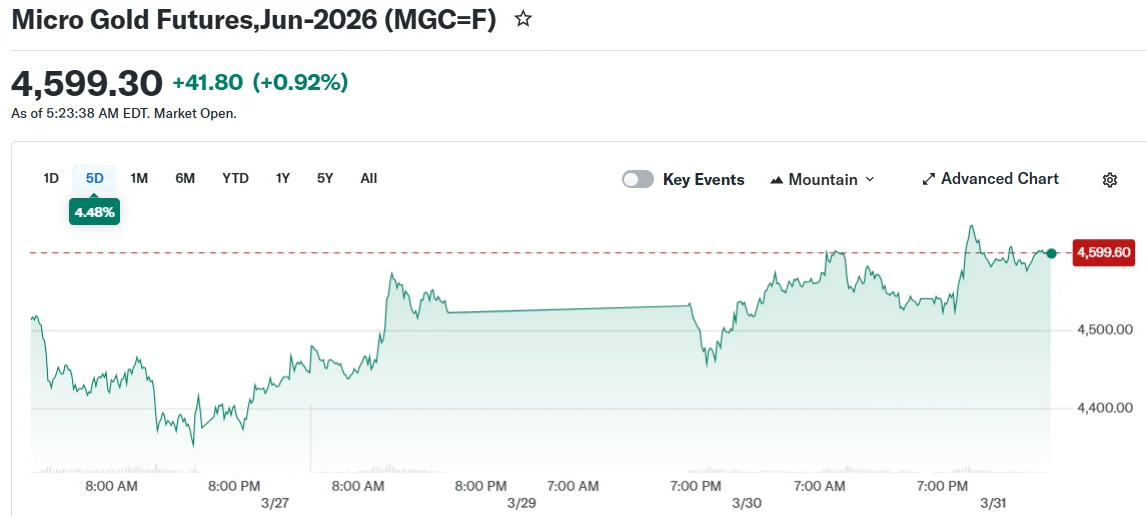
March proved exceptionally challenging for gold investors. The precious metal declined roughly 13% during the month, hovering around $4,500 on Tuesday. This represents the most severe monthly percentage decline for gold in 17 years. The metal reached an all-time peak near $5,500 on January 29 before entering correction territory.
Escalating military tensions in the Middle East stand as the primary catalyst behind the price decline. The regional conflict has created energy supply disruptions and heightened inflation expectations, prompting markets to eliminate anticipated Federal Reserve interest rate reductions for 2026.
Goldman analysts Lina Thomas and Daan Struyven calculate gold’s present fair value at approximately $4,550, accounting for prevailing macroeconomic conditions. This valuation incorporates existing policy hedges.
The analysts emphasize that gold continues to function as a protective asset. They point out that gold’s reaction varies based on inflation’s underlying cause. Supply-side inflation, similar to current market dynamics, typically benefits broader commodities. Gold demonstrates stronger performance when inflation anxieties stem from questions about monetary policy credibility.
“Like in 2022, gold typically underperforms initially in supply disruption episodes,” the analysts wrote. Higher yields raise the opportunity cost of holding gold, and equity selloffs can force margin-related liquidations.
Three Pillars Supporting the $5,400 Projection
Goldman’s bullish outlook relies on three core components. The primary element involves speculative positioning on Comex futures returning to historical norms, which the bank quantifies at approximately $195 per troy ounce.
The second component centers on Goldman’s economics team maintaining expectations for two Federal Reserve rate reductions during 2026, which analysts estimate would contribute around $120 per ounce to gold prices.
The third pillar anticipates renewed momentum in central bank gold acquisitions, returning to roughly 60 tonnes monthly. Goldman calculates this factor alone could contribute $535 per troy ounce.
Net speculative positioning on Comex has now fallen to the 39th percentile. Goldman says the market is in “cleaner” shape and at a “more attractive entry point.”
Potential Headwinds and Bear Scenarios
Goldman acknowledges meaningful downside possibilities. Extended disruption to shipping through the Strait of Hormuz, coupled with additional equity market deterioration, could drive gold toward $3,800 in an adverse scenario.
The bank rejected speculation regarding potential gold reserve liquidation by Gulf central banks. Gulf states maintain relatively smaller gold allocations compared to Turkey, which divested approximately 52 tonnes. These nations operate currency systems anchored to dollar pegs, making U.S. Treasury holdings more probable candidates for reduction than gold reserves.
Looking beyond 2026, Goldman identifies upside potential exceeding $5,400. Geopolitical instability and mounting concerns regarding Western government debt sustainability could propel gold to $5,700, with additional hedging activity potentially driving prices to $6,100.
The Iranian conflict has now persisted for one month without diplomatic resolution. President Trump has stated the U.S. would strike Iran’s energy facilities should the Strait of Hormuz blockade continue.
