



TLDR
- BTC reached approximately $72,000 following Treasury Secretary Scott Bessent’s intervention to stabilize oil markets.
- A collaborative regulatory approach called the “Joint Harmonization Initiative” was unveiled by the SEC and CFTC for digital assets.
- Exchange reserves have decreased to approximately 2.75 million BTC, marking the lowest point since 2019.
- Approximately 14.5 million BTC remain under the control of long-term holders who continue to maintain their positions.
- Corporate accumulation reached nearly 350,000 BTC during a recent period, reducing available exchange supply.
Bitcoin reached just under $72,000 on March 13, 2026, driven by favorable regulatory developments and increasing evidence of tightening market supply.

The upward movement gained momentum mid-week when the U.S. Securities and Exchange Commission and the Commodity Futures Trading Commission revealed plans to collaborate on a unified approach to digital asset regulation through the “Joint Harmonization Initiative.”
This collaborative framework establishes formal channels for data exchange, simplifies compliance reporting, and consolidates enforcement activities previously handled separately by both agencies. Markets responded positively to the announcement despite its non-binding nature.
The development reflects President Trump’s ongoing effort to establish clearer regulatory guidelines for the cryptocurrency sector. The current administration has appointed crypto-friendly leadership to both regulatory bodies.
Energy markets introduced volatility during the week. Crude prices increased nearly 10% to approach $100 per barrel on Thursday, partially driven by U.S.-Israel tensions involving Iran. Traditional equity markets declined in response, affecting overall risk sentiment.
Treasury Secretary Scott Bessent addressed the situation Thursday evening through a post on X, announcing U.S. authorization for purchasing Russian oil currently in transit at sea. He characterized the price increase as a “short-term and temporary disruption.”
Crude prices declined approximately $2 per barrel following the announcement. Bitcoin, which had maintained levels around $70,000 throughout Thursday, advanced to nearly $72,000 soon afterward.
Bitcoin Supply on Exchanges Hits Lowest Level Since 2019
Centralized exchange reserves declined to roughly 2.75 million BTC as of March 12, based on CryptoQuant data. This represents the lowest recorded level since 2019.
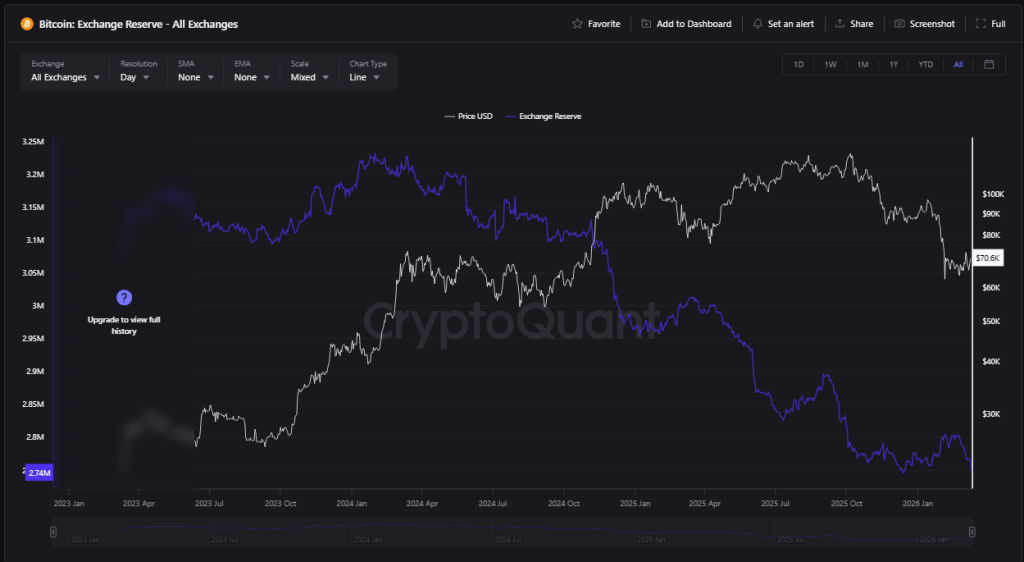
Long-term holders maintain control of approximately 14.5 million BTC — defined as coins unmoved for more than five months. Multiple factors drive this decline: individual and institutional investors transferring coins to cold storage, spot Bitcoin ETFs absorbing available supply, and corporate treasury strategies.
Spot ETFs recorded approximately $570 million in net inflows during a single week. Exchange withdrawals reached 32,000 BTC on one particular day.
Corporate Buyers Continue Adding Bitcoin
Strategy, the company formerly operating as MicroStrategy, maintains its acquisition program. Publicly traded companies accumulated nearly 350,000 BTC during a recent timeframe.
Diminished exchange inventory means moderate demand can generate significant price movement. Market observers characterize the current environment as a supply squeeze.
Bitcoin experienced downward pressure throughout February, declining to the low $60,000s before staging a recovery. Recent trading has occurred within a $67,000 to $71,000 range. Moving above $72,000 could activate forced liquidations from short positions, creating additional upward momentum.
Daily trading activity remains above $50 billion. Mining operations face electricity-based breakeven costs between $64,000 and $65,000.
