



Key Points
- Gold experienced a nearly 5% decline Tuesday before recovering up to 2% Wednesday as buyers stepped in at lower levels
- The US dollar’s approximately 1.5% weekly gain is limiting gold’s upward momentum
- Geopolitical tensions between the US and Iran continue to support safe-haven buying while simultaneously elevating oil prices
- Higher oil prices are increasing inflation concerns, leading markets to reconsider Federal Reserve rate cut timing
- Market expectations have shifted to 80% probability of more than one rate reduction this year, compared to two cuts anticipated last Friday
Gold markets experienced significant volatility as Tuesday’s steep decline gave way to Wednesday’s recovery while investors balanced competing market forces.
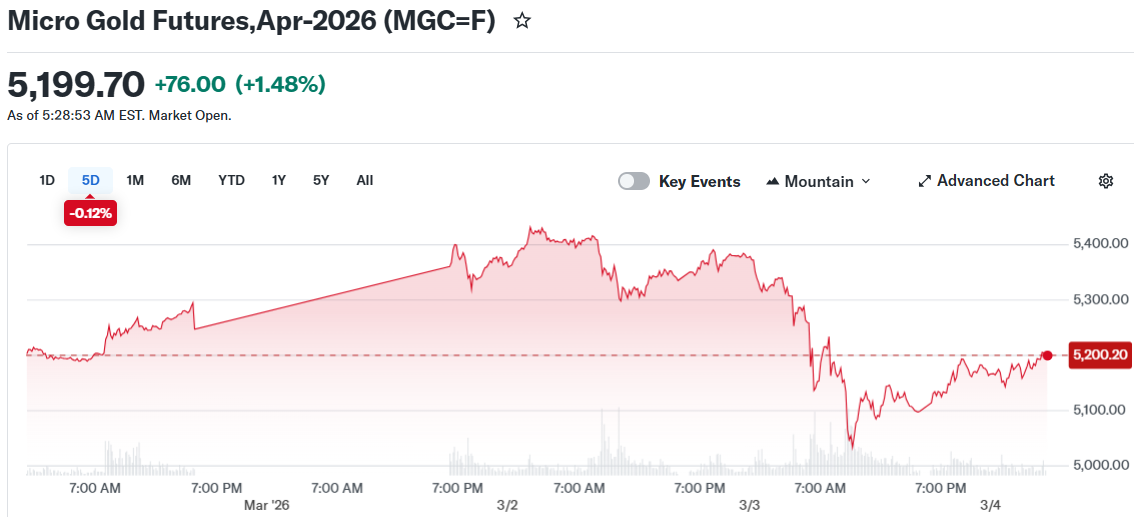
Spot gold climbed 1.6% to $5,171.89 per ounce during late morning London trading. This recovery followed the previous session’s 4.5% decline, representing one of the more substantial single-day retreats in recent months.
The precious metal reached an all-time peak exceeding $5,595 per ounce in late January. Year-to-date gains have approached 20%.
The US Dollar Index surged approximately 1.5% across two days to six-week highs, triggering Tuesday’s selloff. Dollar strength increases gold costs for purchasers holding other currencies.
Portfolio rebalancing also contributed to selling pressure as investors liquidated gold positions to offset losses elsewhere in their holdings.
Silver plummeted more than 8% Tuesday before rallying 4.1% to $85.38 on Wednesday. Platinum declined 10% before advancing 2.8% to $2,148.50 per ounce.
Geopolitical Tensions Support Precious Metals
The US-Israeli military operations against Iran entered their fifth day. Israel conducted additional strikes on Tehran Tuesday, targeting a building in Qom where clerics were reportedly convening to select a successor to Supreme Leader Ayatollah Ali Khamenei, according to Israel’s Kan News. Iran’s semi-official Mehr news agency acknowledged the strike while stating the building was unoccupied.
Ongoing conflict has created uncertainty across global financial markets. Regional instability concerns intensify as Iran continues issuing retaliatory warnings following US strikes on Iranian-connected facilities.
Shipping through the Strait of Hormuz has decreased dramatically. This waterway typically handles approximately one-fifth of global oil and gas transport. President Trump announced US provision of naval escorts and insurance coverage for oil tankers navigating the passage, though shipping industry representatives characterize the measure as an incomplete solution.
Oil Price Surge Influences Monetary Policy Outlook
Elevating crude prices are amplifying inflation projections. This development is causing central banks, particularly the Federal Reserve, to reassess the timeline for potential rate reductions.
Market pricing currently reflects 80% probability of more than one quarter-point Fed rate decrease this year. Markets were fully anticipating two cuts as of last Friday.
Rising interest rates present challenges for gold given the metal generates no yield.
CFTC data indicates money managers’ net long positions in gold have declined since late January to approach decade-low levels. Market analysts suggest this reduced positioning may provide downside support for prices.
Chinese economic indicators delivered mixed signals as official PMI data revealed manufacturing contraction while a private sector survey exceeded expansion forecasts in the world’s second-largest economy.
